4. Strategy
Current approaches to computational miRNA detection relies on homology relationships
or detection of hairpin-loop candidates with lower folding energy. A complete set of
tools to automatize this task have been assembled on miRNAture. This current
approach combines two different sequence-homology modes, using blast or HMMer, and
a secondary structure validation step, performed by the INFERNAL package. Merging and
consolidating task from multiple search strategies is done automatically by miRNAture,
throwing at the the end of the Homology searches stage, a list of regions that
reported highest scores based on selected homology searches. Those candidates
passed designed filters (see in more detail in Fig. 4.1), to be considered as homologs by the
applied computational searches.
Further structural and microRNA-specific evaluations are covered on the
Mature evaluation step, which makes use of an updated version of the original MIRfix
pipeline [21]. At this step, miRNAture evaluates the identity at
family level of the homology candidates found in the previous step. Based on
that, makes use of the reported precursor, mature and genomic information contained on the
miRBase database. Specially for this step, this curation step is prepared
and reported with each release, allowing the user to perform the best mature positioning
and assignment on their predicted precursor sequences. Please refer to the
Appendix section to know more details about the curation process of
the miRBase database and the generation of associated data. At this point,
for each of those precursors, MIRfix will try to:
Assign the best-fitting mature sequence from those reported for the discovered miRNA family.
Predict the position of the miR* and correct the precursor sequence, based on the assigned mature.
Evaluate on a multiple structural alignment, the fit of the new annotated precursor in regard existing annotated miRNAs classified in the same family.
Those results are feeded onto additional evaluation steps, that would assign a confidence to each precursor with its associated mature(s), namely: High, Medium or No confidence.
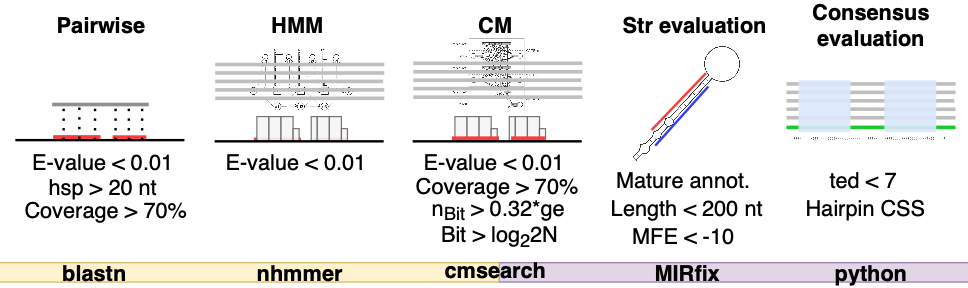
Fig. 4.1 Designed homology/strucrure filters in miRNAture. Specific programs used for each mode in parenthesis. Ann.: Annotation, SS: Secondary structure. CSS: Consensus secondary structure. ge: gathering cutoff from Rfam family. nBit = Bitscore/ge. ted: tree edit distance between default miRNA and modified multiple stockholm alignments. MFE: Minimum free energy. HSPs: high scoring pairs.
In the complete mode, miRNAture will report the following output files:
GFF3andBEDfiles of the precursors with their mature sequences.
Fastasequences from miRNA precurspors.A summary table describing features of found miRNAs, such as: their loci number, family classification and their confidence.
Current workflow is depicted in Fig. 4.2:
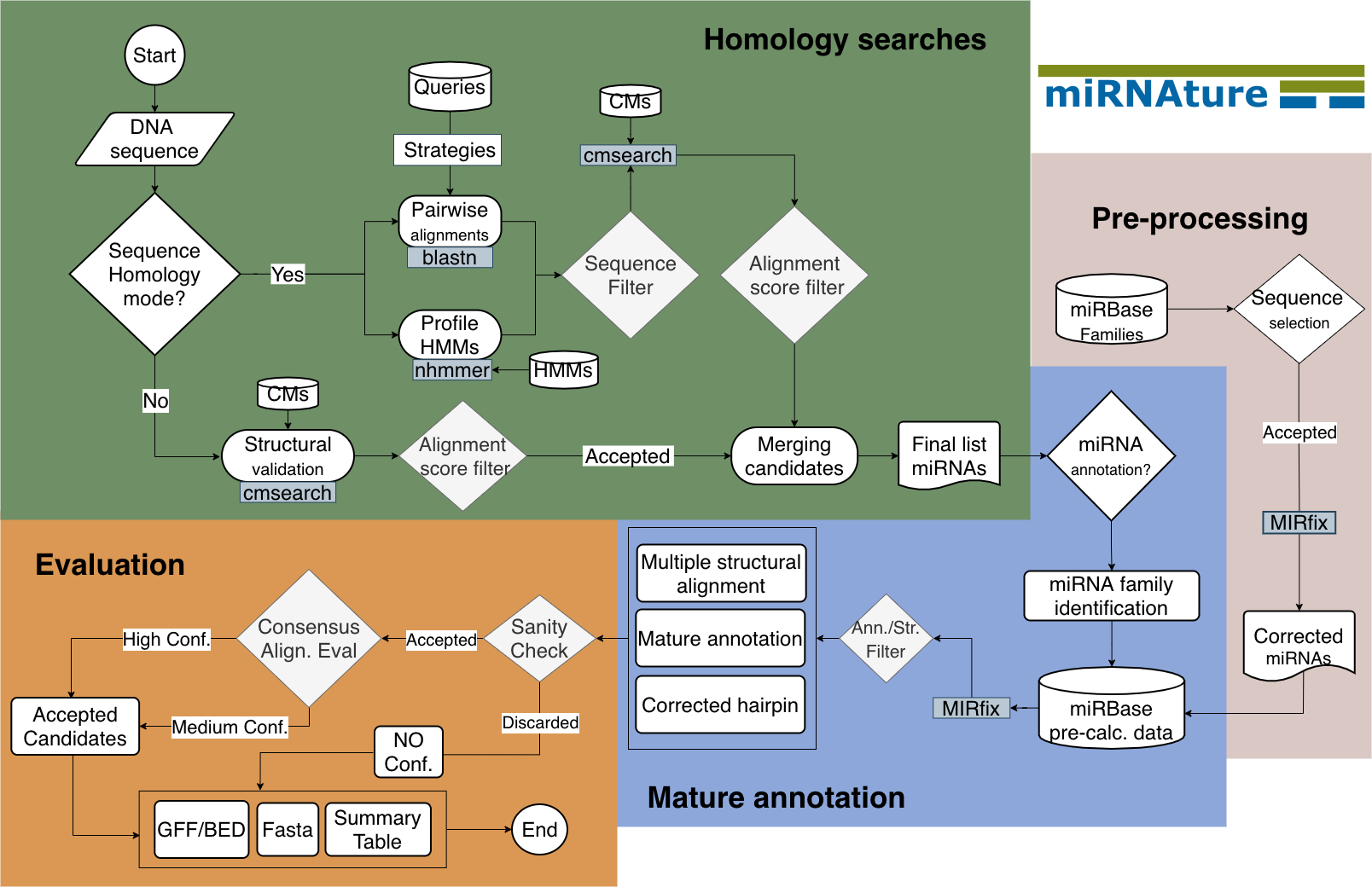
Fig. 4.2 General miRNAture workflow.